We’ve lengthy been within the period of “one man band” media manufacturing. Outdoors of main digital cinema or documentary productions, most video and sound right now are recorded with a minimal crew and funds. That usually means just one individual.
This was an almost unimaginable activity—fraught with easy errors that might endanger all the manufacturing. Now, recording high-quality audio within the discipline is extra foolproof than ever because of a brand new expertise first launched in 2019.
Groundbreaking Tech
Over the previous 12 months, this groundbreaking expertise has shortly caught on and now seems in a spread of very low-cost, skilled audio recorders. Known as “32-bit float audio recording,” it permits the recording of sound with out the consumer having to set achieve ranges.
32-Bit float graphic (Picture credit score: Frank Beacham)
Don’t confuse 32-bit float recording with the previous “auto achieve” setting discovered on most conventional audio recorders. The artifacts produced by auto achieve had been by no means acceptable for professional-quality sound.
Right this moment, the corporate with probably the most 32-bit float recorder fashions is Zoom, adopted by Sound Units and Tascam. Most video modifying software program and digital audio workstations can now play again 32-bit float audio. The fee and high quality of the tools has hit new ranges up to now few months.
What’s so particular about 32-bit float recording? Clipped recordings over zero dBFS could be absolutely recovered with out distortion. With standard 16- and 24-bit audio recording, this was not doable. With 16- and 24-bit recording, if the audio degree peaked above zero dBFS, it was completely distorted. That’s as a result of these digital codecs lack the flexibility to file any knowledge over this threshold.
With 32-bit float recording, the system can file audio knowledge +770 dB above zero dBFS and –758 dB beneath. It is a dynamic vary at an astounding 1,528 dB.
It’s arduous to understand this vary for the reason that loudness distinction between the quietist anechoic chamber to the loudest sound doable is barely 185 dB. With 32-bit float, clipping is now unimaginable.
The Good with the Unhealthy
After all, as with all new expertise, there are some negatives to utilizing and relying on 32-bit float audio. Initially, the recorded recordsdata are a few third bigger than customary 24-bit recordsdata. The consumer will want bigger measurement flash playing cards for audio storage.
If distortion creeps in earlier than the recording begins, 32-bit float gained’t assist save the session. Widespread issues are an overloaded mic capsule, energy line hum or overload from wind.
Even when utilizing 32-bit float, sound operators nonetheless have to do right mic placement, use the proper mic mounting gear and make use of good wind-protection practices when working within the discipline. It’s at all times necessary to examine that the sign being recorded is problem-free earlier than hitting file.
A very powerful change with 32-bit float is that operators don’t must set or fear about sound ranges throughout recording. That is an advance that removes a key activity for overworked one-person sound recordists. It frees the thoughts to focus on different issues throughout the manufacturing.
Even with 32-bit float, manufacturing workflows together with modifying, mixing and distribution proceed to make use of a 24-bit workflow. This implies some knowledge can be misplaced sooner or later within the chain. An audio engineer might want to make changes to make sure that the audio sign doesn’t get clipped when downsampling to 24-bit.
At this level, there’s a selection: Both set ranges correctly on set and file immediately in 24-bit, or file in 32-bit float and add the additional step later. It’s a part of the method that’s important. However it’s at all times simpler to repair degree issues in put up than having them on location.
Product Introductions
Simply earlier than Christmas, 2022, Zoom launched a collection of 32-bit float recorders that units a brand new customary for high quality, options and worth. Known as the M-Collection and beginning at $199, these new recorders are available handheld and shotgun kinds.
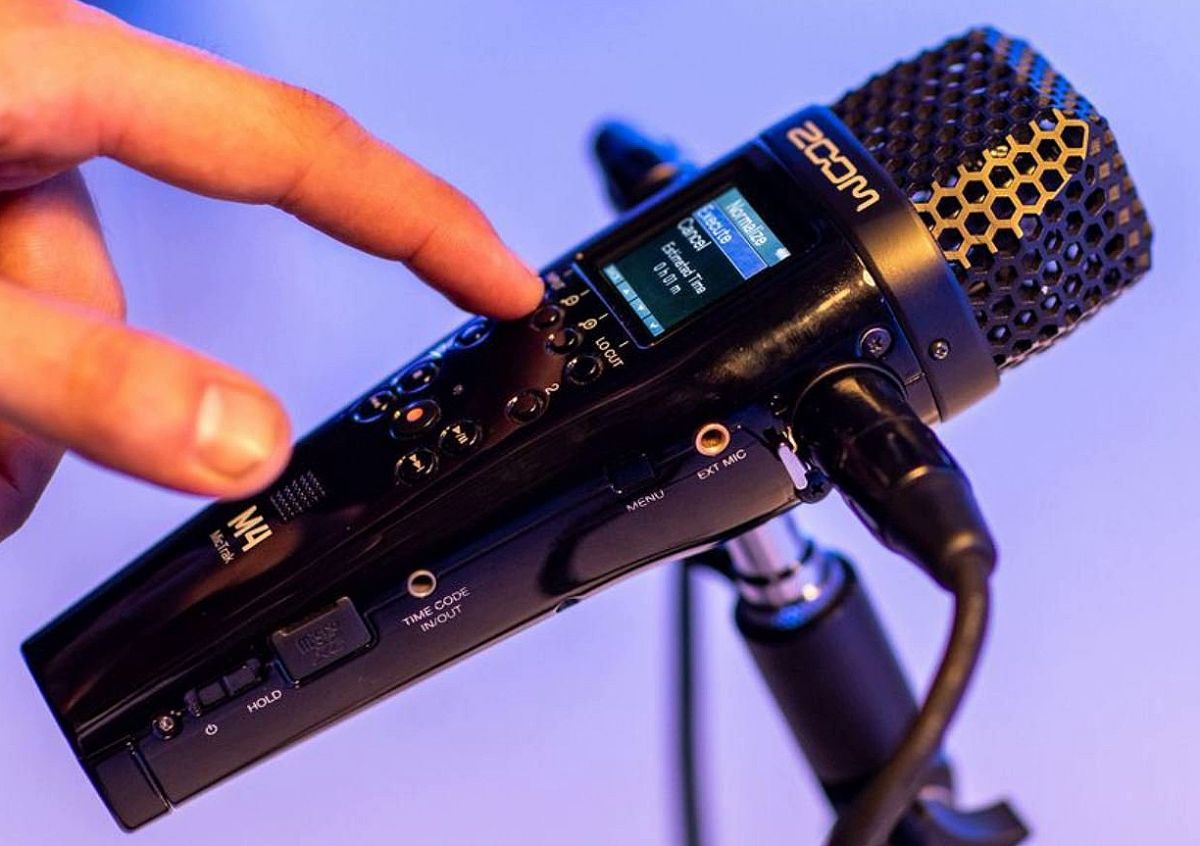
Most attention-grabbing is the brand new Zoom M4 MicTrak ($399), a brand new handheld microphone-shaped recorder. It options 32-bit float recording; 192 kHz pattern price; simultaneous recording of as much as 4 discrete channels; two ultra-low noise pro-quality XLR preamps; and an inside timecode generator.
Journalists can simply use this new recorder for handheld interviews. Simply flip it on and hit file. No have to set ranges. The colour on-screen show reveals a waveform to substantiate recording. The reporter can focus on the content material of the interview, fairly than on the tools.
When 4 mic channels are wanted, two professional mics could be plugged into the XLR jacks on the facet of the M4. It additionally takes 3.5mm enter mics and has an inside timecode generator with an in/out jack. The timecode oscillator gives correct code with a discrepancy of lower than 0.5 frames per 24 hours.
One other main advance is the brand new recorder’s super-quiet preamps, that are taken from Zoom’s high-end F-series recorders. The preamps have a self-noise ranking of -127 dBu. It is a degree of recording expertise exceptional even just a few years in the past.
Tascam Portacapture X8 (Picture credit score: Tascam)
Additionally not too long ago launched was Tascam’s Portacapture X8 recorder ($389.99) and Zoom’s F2 Transportable Discipline Recorder ($229.99), each with 32-bit float recording. These be a part of Zoom’s current F-series fashions and Sound Units MixPre II collection, starting at $895.
Sound Units MixPre 3 II (Picture credit score: Sound Units)
Although 32-bit float recording doesn’t remedy all recording issues, it’s a significant step ahead for recordists working solo within the discipline. Simply as with lighting, good sound recording calls for a posh set of decisions that was a devoted job in itself.
Poor sound has historically been the largest killer on low-budget, unbiased video productions. Till not too long ago, audio couldn’t be recorded so simply and reliably by solo operators. That has now modified, because of 32-bit float audio.